
Introducing SensoryOps
Sense the trend. Perfect the batch.
A physics-informed AI for the alcoholic beverage industry.
The thesis
SensoryOps predicts every batch of alcohol in real-time. The model is physics-informed, so it generalises past any point the sensors have seen. Correct drift before it becomes waste.
A physics-informed neural network learns your mash tun's thermodynamics and enzyme kinetics – so it generalises past any point your sensors have seen. In validation: 1.27% L² error across a full 60-minute cycle.
- 01Target vessel
- Industrial mash tun10,000 L · continuous production line
- 02Model
- 2-head PINN18 enzyme params · coupled ODE + 1-D heat
- 03Integration
- 4-week wire-inOPC-UA + MQTT · no PLC replacement
Where the physics plugs in
Four moments in every batch.
SensoryOps runs a physics-informed digital twin of each vessel on your line and surfaces a prediction at the four moments where flavour is set and drift is cheapest to correct.
- 01Michaelis-Menten
Mash
Enzyme kinetics set 80 per cent of the finished flavour. The PINN forecasts Brix, pH, and α/β-amylase conversion for every minute of the rest curve.
- 02Darcy flow
Lauter
Wort clarity and extract efficiency depend on grain-bed permeability. Off-spec runs are flagged before the first litre leaves the vessel.
- 03Arrhenius
Boil
Hop isomerisation and DMS evolution. The model forecasts IBU and volatile load from the boil profile so adjustments land before a cool-down is wasted.
- 04Monod kinetics
Fermentation
Yeast kinetics under varying pitch rate and temperature. The digital twin predicts attenuation curves and ester load for the cellar team.
01 · The problem
Alcohol is made at industrial scale, and a meaningful share of every batch never makes it to bottle.
Why? Each batch drifts away from its target formulation while it's being made.
Why can't the production line stop it? By the time the on-line sensors catch the drift, the chemistry has already gone past the point of recovery – and a 200,000-litre mash cannot be rewound.
SensoryOps closes that gap.
- 01
- 85%
of new consumer-packaged goods fail within two years of launch.
NielsenIQ
- 02
- $5M
average cost of a failed product launch in R&D, marketing, and inventory.
PDMA, 2024
- 03
- 12–18 mo
the R&D cycle before a production line is locked in and committed.
CPG Timeline Guide, 2025
Physics of drift
Most products don't fail because the concept was wrong – there genuinely is demand for a mango hard seltzer or a low-calorie RTD gin cocktail. They fail because the formulation that tastes right in a 5-litre lab batch doesn't taste right in a 10,000-litre production run. The flavour drifts. The mouthfeel changes. By the time the manufacturer notices, the R&D cycle has already committed them to production, marketing, and distribution.
The lab-to-line gap is a physics problem dressed as a process problem. At 5 litres, a master distiller can hold a grain bed within ±0.2°C for every minute of the mash rest. At 10,000 litres, the grain bed is a 45-centimetre-deep thermal insulator – a temperature change applied at the recirculation loop takes 10 to 15 minutes to reach the bottom.[1] The enzymes do not wait: α-amylase inactivates on a sharp Arrhenius curve above 72°C, β-amylase above 65°C.[2] Those ten minutes of thermal drift are enough to shift the fermentability of the wort by several percentage points – which shows up in the finished batch as body, mouthfeel, and residual sweetness that the lab recipe never predicted.
Today's counter-measure is a tasting panel five hours after the mash is already done. That is too late to adjust this batch, and too slow to close the loop on the next one. What the industry needs is a way to predict the final flavour-critical numbers – Brix, pH, ester load – before the first litre runs, using the physics of this specific vessel, with this specific grist, at this specific ambient. That is the SensoryOps thesis.
Sources
- 1 Fix, G. – Principles of Brewing Science, Brewers Publications, 1999.
- 2 Laus, M. et al. – Enzyme inactivation kinetics in large-scale mashing, Food and Bioprocess Technology, 2022.
02 · Why now
The category is shifting faster than the production lines can reformulate.
- 01
- US$69.7bn
UK alcoholic beverages market – SensoryOps's beach-head.
Statista, 2025
- 02
- 2×
forecast global RTD growth 2019–2029 – premium value outpacing the rest of beverage alcohol.
IWSR RTDs Strategic Study, 2025
- 03
- US$830bn
in shareholder value destroyed since 2021 – reclaimable by producers who can reformulate batch-by-batch.
Bloomberg, 2025
Where the value goes
Ready-to-drink cocktails are the fastest-growing category in alcohol, with independent market-research estimates putting the compound annual growth rate somewhere in the 11.8 to 15.7 per cent range through the end of the decade (Straits Research, 2025; Polaris Market Research, 2025). IWSR, in its own RTDs Strategic Study, forecasts the category doubling globally between 2019 and 2029 with premium value outpacing volume. Gen Z drinkers aged 21 to 27 now match the general drinking population at 74 per cent – they drink differently, not less (IWSR, 2025). Investors are already pricing in the manufacturers' inability to adapt: the companies that can reformulate line-by-line, batch-by-batch, will win that value back.
The bottleneck is not creativity – RTD R&D teams have never been more fluent in what Gen Z wants. The bottleneck is the 12-to-18-month journey from a prototype that tastes right in a 5-litre vessel to a production line that reliably makes the same thing at 10,000 litres, batch after batch. SensoryOps collapses that journey by closing the loop between the flavour target a manufacturer needs and the physics of the vessel it has to run in.
03 · The closed loop
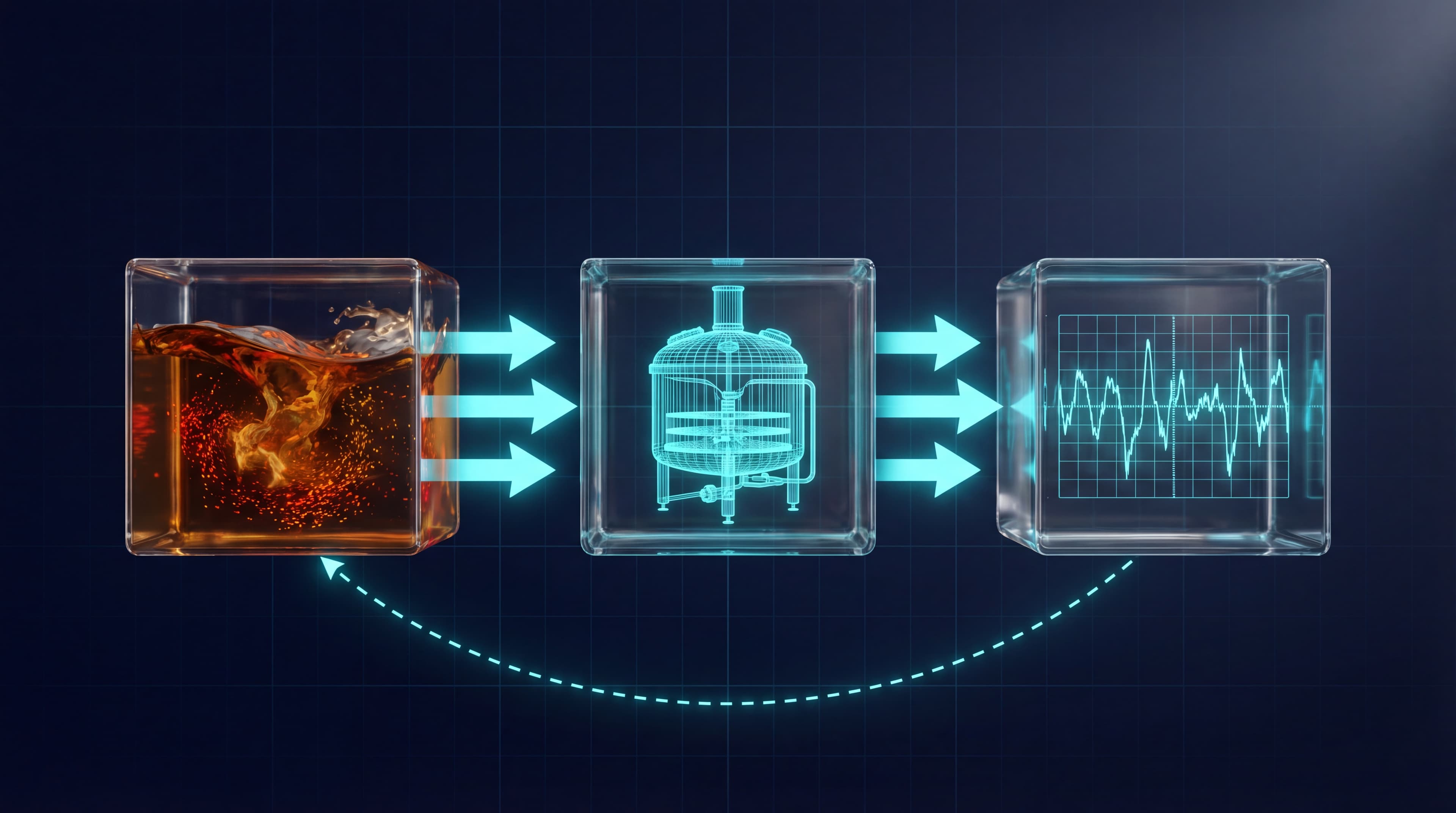
The closed loop.
Three steps. One continuous loop. Each batch that ships refines the next batch's prediction, so the digital twin gets more accurate the more you brew.
- Step 01
Sense
SensoryOps ingests category-level taste signals – RTD shelf data, social listening, Gen Z sensory trials – and compiles them into chemical targets a production line can actually run against. Target Brix, pH, bitterness, ester load.
- Step 02
Simulate
A physics-informed neural network, trained on this vessel's geometry and this grain bill's enzyme profile, predicts what will come out the bottom valve – before the mash starts. Every forecast is constrained by Fourier's Law and Michaelis-Menten kinetics, so the prediction is physically consistent, not just statistically plausible.
- Step 03
Actuate
Optimised setpoints push straight to the PLC: mash rest temperatures, hold times, recirculation rates. The batch hits the target the first time. Shelf performance feeds back into step one, and the loop tightens.
04 · The capabilities
Three things the PINN actually does.
Each pillar carries a proof. A sourced number from the current v1.0 run or the integration spec, not a hit rate invented for the pitch.
- 01Proof
Predict
Forecasts every batch's final Brix, pH, conversion, and thermal gradient before the first litre runs. One inference per scenario, sub-second on commodity hardware.
1.27%L² error · sugar term, 60-minute rest · predictions_vs_ground_truth.json - 02Proof
Explain
Every prediction ties back to a physics equation. The operator sees the Fourier residual, the Michaelis-Menten constants, and the L² error before accepting a setpoint change. Audit-ready on day one.
6 termsphysics-constrained loss decomposition · training_loss.json - 03Proof
Deploy
Four-week wire-in using the standards the plant already speaks. OPC-UA + MQTT, no PLC replacement, no rip-and-replace. The digital twin runs alongside the line and hands setpoints forward, not backwards.
£50k + £120k/yrintegration + per-line SaaS · see /pilot
05 · Pilot
For the production lines that already run at industrial scale.
SensoryOps is designed for the global brewers – Diageo, AB InBev, Pernod Ricard – whose production lines run continuously and whose R&D teams are under pressure to reformulate line-by-line. We are not building a tasting app or a shelf-trend report. We are building the physics layer that turns those reports into batches that hit the target the first time.
Gastrograph AI, the closest ‘AI + taste’ comparable, was acquired by NielsenIQ in April 2025 (NIQ press release, 7 April 2025). PhysicsX, the closest ‘physics-informed AI’ comparable, raised $135M Series B in June 2025 at a near-unicorn valuation (GlobeNewswire, 23 June 2025). SensoryOps sits at the intersection – consumer-insight AI and physics-informed AI, applied to the one vertical where both matter at once.
06 · Pricing
Pays for itself against one off-spec batch.
PDMA estimates the average cost of a failed product launch at approximately $5M (PDMA, 2024).
Integration (one-off)
£50,000
- Vessel geometry capture and PLC integration survey
- PINN training on historical batch logs from the pilot line
- Onboarding: 4 sessions with the R&D team
SaaS, per production line
£120,000/ yr
- Unlimited batch forecasts and scenario simulations
- Real-time digital-twin dashboard (live demo: /dashboard)
- Quarterly model refreshes as the line's data grows
07 · See the PINN run
Open the live
dashboard.
No sign-up, no login. The full proof-of-concept runs on pre-computed PINN output: thermal field, enzyme kinetics, scenario sweeps, 3D mash tun render.